British Cabinet
The IPCRESS FileThe British Cabinet is the hidden political authority behind the novel’s most consequential intelligence arrangements: it stands above WOOC(P), receives reports from the Unnamed narrator, and defines the jurisdiction he invokes when other officials try to handle a sensitive file. It rarely appears as an active presence, but its distance gives its authority force. The organization’s significance lies in the gap between its high-level command and the secret, improvised work carried out in its name.
Position and Delegated Authority
A fragment identifying WOOC(P) gives the Cabinet as its origin and records an authority designation of PH 6. The novel later clarifies the chain of responsibility through Dalby, whose department answers directly to the Cabinet. This direct link helps explain why Dalby can operate at the margins of ordinary military administration while remaining exceptionally powerful within the intelligence world.
The consequences of that delegated status are practical as well as political. People posted to WOOC(P) are, for most purposes, no longer part of the Army and are removed from almost all War Office records. Those returning to regular duty are enlisted afresh and assigned new serial numbers; their pay follows a separate scale. The Cabinet is not shown administering these procedures itself, but its position at the head of Dalby’s department places its authority above an organization designed to evade ordinary institutional visibility.
The Cabinet as the Unseen Upstairs
In a discussion of Jay, Dalby uses the idea of people being upstairs to refer to the Cabinet. He says Jay has friends there, while also stressing that there is no evidence linking Jay to illegal dealings since 1950. The suspicion is therefore a lead, not an established finding. Dalby describes Jay’s movements during the Burgess and Maclean affair: Jay was in Cairo while Maclean was stationed there, and later travelled with Maclean and Burgess on a cross-Channel voyage. Of the three, only Jay returned to England. These details make Dalby’s remark about high-level connections troubling, but they do not prove that the Cabinet assisted Jay or knew of his activities.
The Cabinet’s distance from the investigation also sharpens the story’s uncertainty. Intelligence officers can identify coincidences, associations, and possible access to power without being able to convert them into proof. The organization is presented as the highest point in the hierarchy, yet its supposed connection to Jay remains an inference voiced by Dalby rather than a resolved revelation.
Reporting Lines and the Henry File
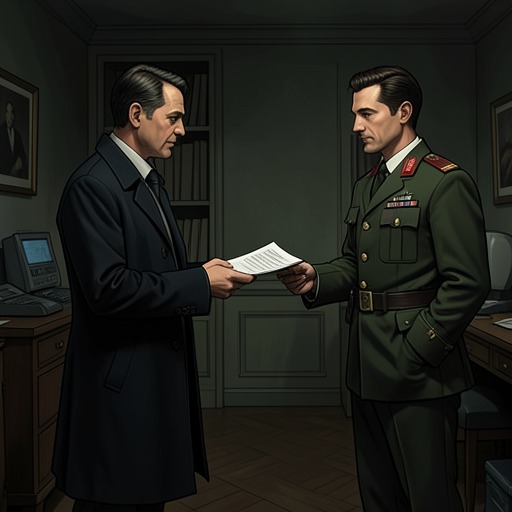
The clearest direct encounter with Cabinet authority comes when the Unnamed narrator confronts the EMP over a file concerning Henry, the man who phoned Jay. The file contains a note in the Prime Minister’s handwriting, the Unnamed narrator’s report, and a lengthy account from Ross. When the EMP and Ross begin discussing it, the Unnamed narrator insists that his report was submitted to the Cabinet and that neither of them has the right to open, handle, or comment on the file. He claims the matter falls within a sphere of activity defined by the Cabinet, takes the file, and asks that it remain top secret pending further reports.
The episode shows the Cabinet’s authority working through jurisdiction and procedure rather than through a visible order. The Unnamed narrator does not establish that the EMP intends to conceal Henry; he acts because he does not want the file misplaced. His appeal to the Cabinet allows him to block competing officials and secure custody of the evidence. The EMP yields, and the Unnamed narrator leaves with the slim green file, resolved to pursue Jay’s highly placed friend. The outcome is a limited procedural victory, not a solution to the Henry mystery.
Institutional Reach and Narrative Significance
The Cabinet’s authority is set against a crowded field of intelligence agencies and overlapping investigations. As senior scientists disappear, Dalby reports that the British Home Office is alarmed; the disappearance of Raven brings the number of senior figures missing to eight in six and a half weeks. Dalby says that finding Raven could give his department leverage to absorb the Home Office files. This is Dalby’s proposed institutional advantage, not evidence that the Cabinet ordered the operation or approved the intended transfer.
That distinction captures the Cabinet’s role in the novel. It represents the top of a system whose agents compete over information, jurisdiction, and access, while the people carrying out its work remain difficult to trace in ordinary records. The Cabinet supplies a final authority that characters can invoke, but it is not a transparent source of answers: even the Unnamed narrator’s report to it leaves Henry unidentified and Jay’s powerful connection unconfirmed. Its narrative presence is therefore both stabilizing and unsettling—an ultimate point of reference within a world where the chain of command is clearer than the truth.